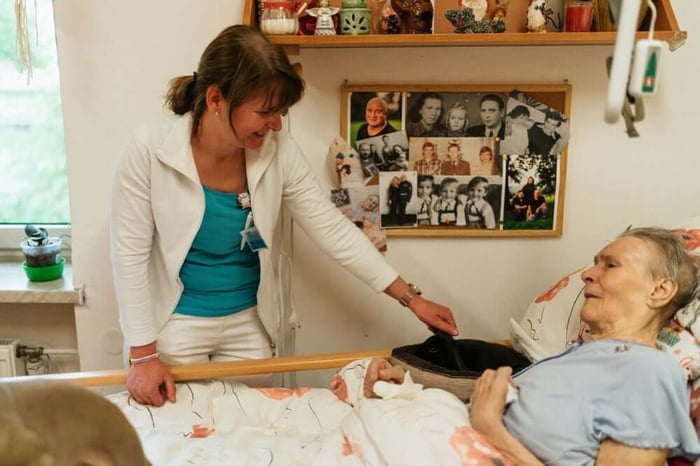

For decades, Margaret Ellis was the one everyone relied on.
She had spent forty-two years as a nurse, most of them in the local hospital where she developed the kind of calm authority and gentle compassion that could set an anxious patient at ease almost instantly.
Margaret had seen and done it all, from inserting IVs in moving ambulances to handling midnight emergencies with coffee in one hand and a flashlight in the other. And, through it all, she always remembered little details about every individual patient. No wonder, then, that Margaret came to be seen as the town matriarch.
What nobody, not even Margaret herself, had ever really considered was what would happen when the roles were reversed.
At seventy-six, after a minor stroke and a stubborn insistence on “managing perfectly fine alone,” Margaret found herself sharing her small suburban home with her daughter Claire for what was supposed to be “just a few weeks.”
Everyone, family and friends alike, knew those words rarely meant what they claimed to mean.
Mother Always Knows Better
“Don’t hover,” Margaret said from the kitchen table without looking up.
Claire stopped mid-step, holding a mug of tea she had been specifically asked to make two minutes earlier.
“I’m not hovering.”
“You sighed.”
“I breathed.”
Margaret adjusted her glasses and cocked an eyebrow skeptically.
The truth was, Claire was hovering a little. It was difficult not to. Three months earlier, her mother had fallen while trying to carry laundry downstairs. The bruises healed quickly. The fear, not so much.
Margaret, on the other hand, seemed almost annoyed by the entire experience.
“I took care of cardiac patients for thirty years,” she liked to remind everyone. “I think I can manage toast.”
Which might have sounded more convincing had the toaster not caught fire the previous Tuesday.
Technically, it was the bagel that caught fire. But still.
The Garden’s in the Bathroom
Caregiving often begins in small humiliations.
Not dramatic ones. Quiet ones.
For Margaret, it was the shower chair.
“What’s the lawn furniture doing in my shower?” she asked with a slightly annoyed tone.
“It’s not lawn furniture,” Claire replied patiently. “It’s a medical shower chair.”
“It has rubber feet.”
“That’s so it doesn’t slide.”
Margaret crossed her arms. “I spent hours at a time on my feet during major operations. I can survive a shower.”
Claire knew better than to push. Years of raising teenagers had taught her that stubborn people don’t do confrontation. And, apparently, that skill transferred seamlessly to aging parents.
So she simply left the chair in the bathroom.
Three days later, she noticed it was wet.
Neither of them mentioned it.
That became the rhythm of things. Quiet adjustments. Silent compromises disguised as coincidences.
The grab bars “weren’t necessary,” but Margaret used them every day. The pill organizer was “ridiculous,” but mysteriously emptied itself correctly each week. The walker was “for old people,” despite the undeniable fact that Margaret herself was, by every mathematical definition available, old people.
Things Caregivers Learn Quickly
Claire discovered quite quickly that caregiving had very little to do with grand gestures.
Mostly, it involved:
- Repeating yourself gently
- Pretending not to notice embarrassment
- Learning which battles were worth fighting
- Becoming strangely knowledgeable about fiber intake
She also learned that exhaustion sneaks up quietly.
Not dramatic exhaustion. Not movie exhaustion.
Just the slow accumulation of interrupted sleep, postponed errands, unfinished conversations, and the strange mental burden of always listening for movement in the next room.
And, by the way, silence can sometimes be far more alarming than noise.
One evening, Claire found herself crying in the grocery store parking lot because she could not remember whether she had already bought bananas.
Not because of the bananas, but because they had become yet one more thing to keep track of.
The Nurse Becomes the Patient
Margaret had developed a deep dislike for appointments, and this deeply amused her former coworkers.
“You used to yell at patients for skipping follow-ups,” one old colleague told her over the phone.
“I encouraged,” Margaret corrected.
“You threatened.”
“Well, it was tough love.”
But being the patient felt different. Vulnerable in a way she had never fully understood from the other side of the bedrail.
People spoke more slowly to her now. Sometimes louder. Occasionally, in that painfully cheerful tone usually reserved for toddlers and confused tourists.
Margaret despised that voice.
One afternoon after a difficult appointment, she sat quietly in the car while Claire drove home.
Finally, she said, “I think this is the first time I understand why some patients get angry.”
Claire glanced sideways. “Because they’re scared?”
Margaret nodded.
Then, after a pause: “And because nobody likes needing help to put on socks.”
The Little Things Matter
Over time, Claire stopped trying to “fix” everything. Instead of correcting Margaret constantly, she adapted quietly. The atmosphere in the house seemed to ease up almost immediately.
She brightened the lightning a little because shadows were making it more difficult to judge depth. She replaced loose rugs with nonslip mats after a scary wobble in the hallway and put the extra armchair in storage to create a bit more space in the living room. Nothing spectacular – just a few subtle changes. But, an enormous boost to Claire’s peace of mind.
But, the most important lesson in all of this - preserving dignity matters just as much as preserving safety.
A Strange Kind of Closeness
Caregiving changed both of them in unexpected ways.
Claire learned things about her mother she had somehow never known before:
- That Margaret hated pears with unreasonable intensity
- That, in 1974, after a few too many on a jam night in a local honky-tonk, she almost eloped to Arizona with a jazz pianist
- That she had kept every Mother’s Day card Claire had ever made, including one featuring a crayoned horse that looked alarmingly like a Stephen King character.
Margaret, meanwhile, began softening around the edges.
Not dramatically. Margaret doesn’t do dramatic.
But one evening, while Claire adjusted the blanket over her legs, Margaret quietly said, “You’re very good at this.”
“Am I?” Claire laughed. “I feel I’m always complaining.”
“That’s part of caregiving,” Margaret replied. “Any nurse who says otherwise is lying.”
The Things We Carry for Each Other
By spring, the routines no longer felt temporary. They felt lived-in.
There were still difficult days. Periodic frustrations like a misplaced hearing aid, sudden early morning stiffness, and arguments about sodium intake that became oddly personal.
But there was also humor. A lot, actually.
Like the time when Claire replaced the batteries in the TV remote three times because Margaret complained it wasn’t working. Until Claire noticed that Margaret was holding the remote back to front.
Or the afternoon they both spent twenty minutes searching for Margaret’s glasses before realizing they were perched on her head.
Twice.
Caregiving, Claire realized, was not defined by one emotion at a time.
It was love mixed with fatigue. Tenderness mixed with impatience. Grief mixed with gratitude.
And somehow, these feelings seem to all exist and play together in some kind of improbable and beautifully strange harmony.
Conclusion
Aging changes relationships. Some changes happen slowly and almost imperceptibly, while others are sudden and almost jarring. Parent and child trade places in the support and nurture department. Confident nurse becomes vulnerable patient. Where once you provided care, you now have to learn how to receive care gracefully.
But hidden within these difficult transitions are moments of extraordinary humanity; quiet acts of patience, compromise, humor, and love that rarely make headlines but shape families forever.
At LL Medico, we understand that caregiving is built around these everyday moments. From mobility aids and bathroom safety products to adult diapers and other practical home solutions, we strive to help families create routines that preserve comfort, dignity, and independence for everyone involved.
To learn more about how our products can make a caregiver’s life that little bit easier, give us a call at (855) 422-4556 or email support@llmedico.com. Our experienced assistants will gladly discuss your specific needs and ideal product choices. We’re available for a call or online chat from Monday to Friday between 9 am and 5 pm EST.
Note to reader. This is a work of fiction. The idea is to portray the evolution of a typical caregiver-patient relationship with lighthearted anecdotes that describe very common, very real caregiving experiences. We hope that you have enjoyed the read.