
Table of Contents
November is American Diabetes Month, and for millions of people it is a reminder of how much daily work sits behind a single blood sugar reading. The Centers for Disease Control and Prevention’s National Diabetes Statistics Report estimates that more than 40 million Americans have diabetes, and the odds rise sharply with age. The report puts the prevalence at 28.8% among those 65 and over compared to 12% overall.
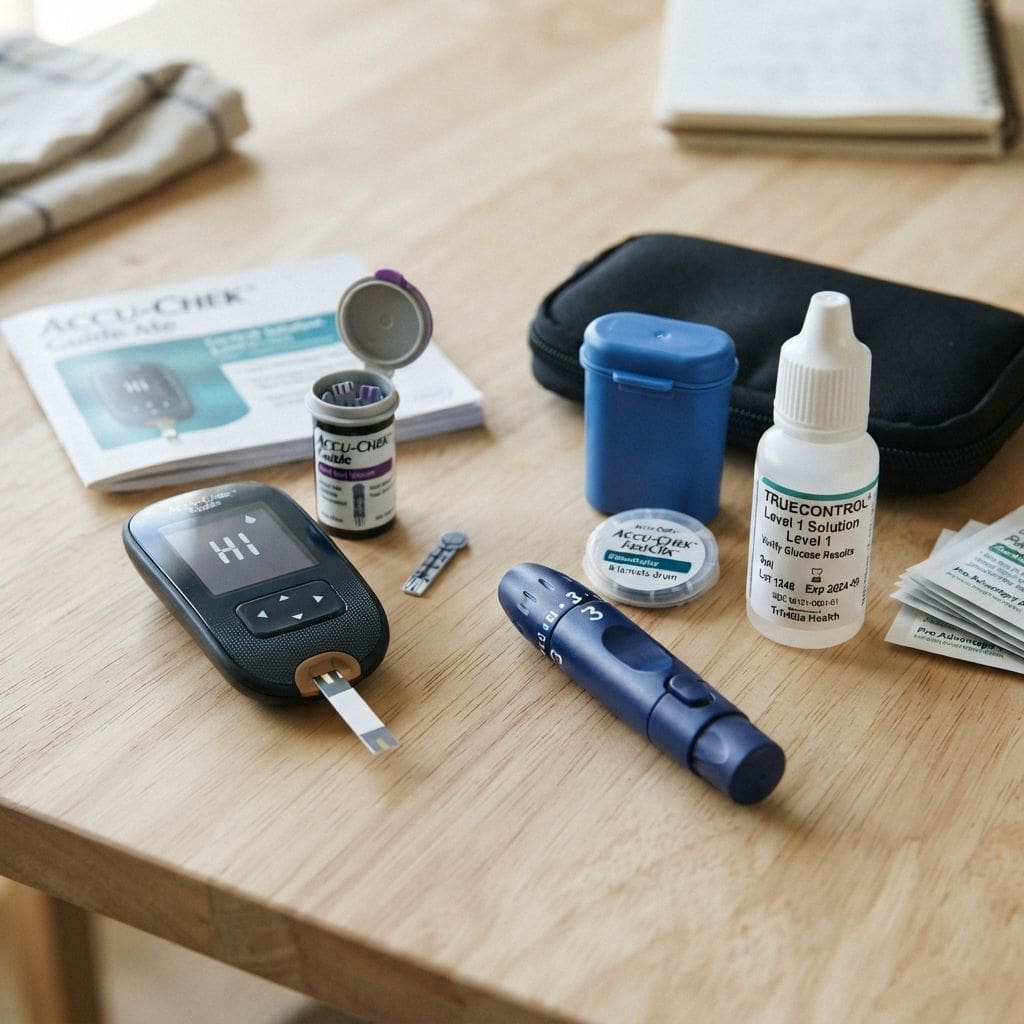
If you know anyone who is diabetic, you already know the meter is only part of the story. The diabetic test strips, lancets, and control solution are what you buy again and again, and they are where most of the confusion, waste, and potentially inaccurate readings come from. In this guide, we cover how to choose, store, and dispose of them safely. In case you haven’t yet decided on a meter, start with our guide to choosing the best glucose monitor.
Test Strips Are Not Interchangeable
The first rule of diabetic test strips is that they generally belong to a specific meter. Strips that look nearly identical can give wrong results, or no result at all, in the wrong meter. Check the model name on the meter, not just the brand, because one company may sell several meters that each take a different strip. When you reorder, compare the name on the vial with the name on the meter every time.
It also pays to avoid secondhand or unauthorized strips. The FDA has warned against using previously owned home-use strips, and a bargain is no bargain if it leads to a dosing decision based on a bad number. Strips are single-use, so never reuse one that has already touched blood or control solution.
For older adults, the practical details matter as much as the brand. A strip that is easy to pick up and insert is a real advantage for shaky hands or arthritic fingers. Look for:
- A small blood sample requirement, which means a gentler fingerstick
- A meter that does not require coding, so there is no code to enter or chip to swap
- Strips sized and shaped for easy handling
- Individually wrapped strips, if opening a vial is difficult
🛒 Product Tip: Before you buy, ask what the strips cost, not just the meter. The meter is often the inexpensive part in the long run, while the strips are the ongoing expense. A meter that takes affordable, widely available strips usually costs less over a year than a bargain meter with pricey ones.How Many Strips Do You Need?
Start with the testing schedule your doctor has set, and do the math. Someone who tests three times a day uses about 90 strips a month, while someone who tests once a day uses about 30. Buying in bulk can lower the cost per strip, but only if you will use them before they expire, so match your order to your actual testing pace.
Coverage can help. According to Medicare, Part B generally covers up to 100 test strips and 100 lancets every three months for people who do not use insulin, and up to 300 of each every three months for people who do. Larger amounts can be covered when a doctor documents the medical need. Control solution is covered too, and a lancing device is typically covered once every six months. You will need a prescription, and the supplier must be enrolled in Medicare for the claim to be paid. Medicare Advantage and private plans can have different rules, so call the plan before ordering.
Because strips are a recurring purchase, a scheduled delivery makes life easier. Reordering when you have about two weeks left keeps you from rationing strips or skipping a test.
Storing Strips and Control Solution
Heat, humidity, and air are hard on test strips, and damaged strips can give inaccurate readings. The basic rules are simple:
- Keep strips in their original vial with the cap closed tightly. Do not move them to a pill box or another container that may not be airtight.
- Store them away from direct sunlight, heat, and freezing temperatures, which rules out the bathroom shelf and the car glove box.
- Keep them away from bleach and cleaning products.
- Never use strips past the expiration date printed on the vial.
Many products also carry a discard date once opened, which may be a few months after opening, while others can be used until the printed expiration date. Check the package insert for your product, and write the date you opened the vial on the label so you never have to guess.
⏱️ Timing Matters: Write the date on every new vial of strips and bottle of control solution the day you open it. Then check the label against the package insert’s discard window each time you restock.Control Solution: The Accuracy Check Many People Skip
Control solution is a liquid with a known amount of glucose. You apply it to a strip instead of blood, and the meter should return a number inside the range printed on the strip vial. If it does, the meter and diabetic test strips are working together properly.
Run a control test when you open a new vial of strips, when you start a new meter, if the meter has been dropped, and any time a reading seems off or does not match how your loved one looks or feels. Many manufacturers also recommend testing at regular intervals, so check your manual.
If the result falls outside the range, do not rely on that meter and strip combination yet. Check that the strips and the control solution have not expired, make sure you used the right control level, clean the meter, and test again. If it still misses, call the manufacturer’s customer service line. Throughout, treat control solution like strips: keep the cap on, and note the opening date.
Lancets: Gauge, Depth, and Comfort
A lancet is the small needle in a lancing device, and a gentler one makes testing something your loved one will keep doing. Two things affect comfort:
- Gauge. The higher the gauge number, the thinner the needle. Thinner lancets usually hurt less, though some people find they need a slightly larger one to get enough blood.
- Depth. Most lancing devices have an adjustable depth. Begin with the shallowest setting that produces a good drop of blood, and increase only if needed. Someone with thick, calloused fingertips may need a deeper setting than someone with soft skin.
Testing on the sides of the fingertips tends to be less painful than the pad, and rotating fingers lets sore spots heal. Warm hands and gentle pressure help produce the drop of blood. Use a fresh lancet every time. Used lancets get dull, which hurts more and raises the risk of infection.
If your loved one has numb fingers, neuropathy can change how a fingerstick feels. Our article on diabetes and peripheral neuropathy explains why this matters. If you have to test for someone with deteriorating vision, our guide to diabetes and vision loss offers useful context.
⚠️ Important: Never share a lancing device or meter, not even between spouses or family members who both have diabetes. The FDA has warned that fingerstick devices used on more than one person can pass on bloodborne infections. Wash your hands before and after helping someone test.Disposing of Used Lancets Safely
Used lancets are sharps, and loose sharps can injure sanitation workers, family members, and pets. The FDA recommends putting used sharps into an FDA-cleared sharps container immediately after use. These are sold at pharmacies and medical supply companies, and smaller travel sizes exist for outings.
If you do not have one, the FDA says a heavy-duty plastic household container, such as an empty laundry detergent bottle, can serve as an alternative when it is sturdy, leak-resistant, upright, and has a tight lid. Never put loose lancets in household trash or recycling, and never flush them. Rules for getting rid of a full container vary by community, and some areas offer drop-off sites or mail-back programs, so check with your local health department or pharmacist. Keep the container where children and anyone with memory loss cannot reach it.
Putting It Together: A Caregiver’s Routine
You do not need a complicated system. A short weekly check will catch most problems:
- Compare strips with the meter model name
- Check expiration and discard dates on strips and control solution
- Count remaining strips and lancets and reorder at the two-week mark
- Check how full the sharps container is
- Run a control test if anything seems off
📥 Download This Guide: Download our free Test Strips, Lancets & Control Solution Quick Reference Guide and keep it with the meter.Conclusion
Managing diabetes at home asks a lot of a caregiver, and the small details around diabetic test strips, lancets, and control solution are easy to overlook until a reading does not make sense. The good news is that a few habits cover most of it. You don’t have to be perfect, just consistent, and each of these steps we’ve discussed here makes your loved one’s numbers more trustworthy.
When you are ready to stock up, LL Medico carries a range of blood glucose meters, glucose meter supplies, and other diabetes care supplies such as glucose shots, nutritional shakes and more. Test strips are a perfect fit for Autoship, which takes 15% off your first order and 5% off each one after, and orders over $49 ship free in the lower 48 states. If you are also managing incontinence, our adult diapers line can also be delivered on the same Autoship schedule.
So, if you have any concerns or doubts about which strips go with your meter or which meter would best suit your situation, our team is always glad to help. Don’t delay, call us today at (855) 422-4556 or email support@llmedico.com.
In closing, we remember the words of Benjamin Franklin, “An ounce of prevention is worth a pound of cure.” A few careful minutes with the supplies each week protect the numbers you both rely on. Small, steady habits are what keep a good day good.
FAQs
Can I use any test strips in my meter?
No. Strips are made for specific meters, and the wrong strip can give inaccurate results or an error. Match the strip name to your meter’s model name each time you reorder.
What if my strips expire before I use them all?
Do not use them. Expired strips can return wrong readings. To avoid waste, order closer to your real testing pace, and ask your supplier about expiration dates before you buy in bulk.
How do I know if my meter is accurate?
Run a control solution test and check the result against the range printed on the strip vial. You can also compare a reading with a lab test at your next doctor visit, and ask your care team how to handle a meter that seems off.
Can I reuse a lancet to save money?
It is not recommended. Lancets dull after one use, which makes the next stick more painful and increases infection risk. Lancets are also one of the least expensive parts of testing, so this is rarely a good place to save.
What do I do with a full sharps container?
Check the label for mail-back instructions, then ask your local health department or pharmacy about drop-off sites. Do not put it in the recycling.