Presbycusis, commonly known as hearing loss in older adults, sometimes progresses so gradually that an older adult may not realize how much their hearing has changed until it becomes impossible to ignore. Family members often notice it first. The television gets louder, conversations become more difficult, and "What?" or "Can you repeat that?" becomes a regular part of everyday conversation.
According to the National Institute on Deafness and Other Communication Disorders (NIDCD), hearing loss affects about one in three people in the United States between the ages of 65 and 74 and nearly half of those over 75.
Hearing loss is more than an inconvenience. It makes it harder to communicate with family and friends, understand a doctor's instructions, hear a telephone or doorbell, and respond to warning sounds such as smoke alarms. It may also make social situations frustrating and contribute to feelings of isolation.
The good news is that hearing loss does not necessarily mean giving up the activities and relationships that make life enjoyable. Recognizing the signs, seeking appropriate professional advice, and making practical changes can make communication much easier.
Understanding Age-Related Hearing Loss
Age-related hearing loss, also known as presbycusis, usually develops gradually. It commonly affects both ears and may become particularly noticeable when a person has difficulty understanding speech in the presence of background noise.
Age is not the only possible factor. Long-term exposure to loud noise, certain medical conditions, genetics, and some medications can also contribute to hearing loss. The NIDCD article also notes that high blood pressure and diabetes can be associated with hearing loss, while some medications can damage sensory cells in the ear.
Because hearing loss often develops slowly, it can be tempting to blame other people for mumbling or assume that everyone on television has suddenly started speaking too quietly. Sometimes the person simply has not recognized that their hearing has changed.
Recognizing the Signs
Some signs of hearing loss are obvious, while others are easy to overlook. An older adult may:
• Frequently ask people to repeat themselves.
• Turn the television or radio volume higher than others prefer.
• Struggle to follow conversations involving several people.
• Have difficulty understanding speech in restaurants or other noisy places.
• Have difficulty hearing on the telephone.
• Say that other people mumble.
• Watch people's faces closely while they are speaking.
• Avoid social gatherings because conversations have become frustrating.
A person may also appear not to respond when spoken to from another room or misunderstand questions because they have not heard them correctly.
This National Institute on Aging infographic identifies several of these behaviors as possible signs of hearing loss. 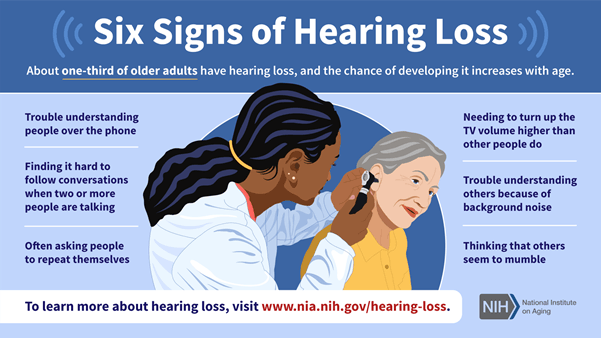
Sometimes the change is noticed through behavior rather than hearing itself. Someone who once enjoyed family gatherings may begin avoiding them, or a person who was always happy to answer the phone may stop doing so.
How Hearing Loss Can Affect Independence
Hearing is closely connected with everyday independence. An older adult who cannot hear clearly may have difficulty communicating with healthcare professionals, understanding instructions, answering the telephone, or recognizing warning sounds around the home.
Hearing loss can also affect social connections. Conversations require more effort when speech is difficult to understand, particularly in noisy environments or when several people are talking. Some people eventually avoid restaurants, family gatherings or other situations where they expect to struggle.
An older person can be mistakenly considered confused or uncooperative when they simply have not heard what was said. For caregivers, this is an important distinction. If someone suddenly seems unusually quiet, confused or disengaged, hearing difficulty should not automatically be overlooked.
Hearing loss can also affect safety. Someone who cannot hear a smoke alarm, doorbell, telephone or other warning sound may need additional visual or vibrating alerts. If hearing loss occurs alongside mobility or vision problems, looking at the overall safety of the home becomes even more important.
How Caregivers Can Make Communication Easier
Small changes in the way you communicate can make conversations considerably easier.
Attract the person's attention before speaking, particularly if you are approaching from another room. Face them while talking, make sure the room is well lit, and speak clearly and naturally rather than shouting. Speaking excessively loudly can distort sound and make speech harder to understand.
Allow a little more time for conversation and avoid rushing. If the person does not understand something, try rephrasing it rather than simply repeating the same words.
Background noise can make hearing particularly difficult, so turn down the television or move somewhere quieter when discussing something important.
When discussing appointments, medications or other important instructions, make sure the information has been understood rather than simply assuming it has.
These adjustments can reduce frustration for both the older adult and the caregiver.
When Someone Does Not Want to Admit They Have Hearing Loss
Some older adults may resist the idea that their hearing has changed. Hearing loss can feel like another unwelcome reminder of aging, and some people may worry about appearing old or dependent.
Arguing about whether someone can hear rarely helps. Instead, focus on the practical problem. Rather than saying, "You can't hear me anymore," try saying, "Let's move somewhere quieter so we can hear each other better."
If communication problems continue, encourage a hearing assessment. A professional evaluation can identify whether hearing loss is present and help determine what options may be appropriate.
Hearing Tests, Hearing Aids and Other Support
If you suspect that an older adult has hearing loss, professional assessment is an important next step. A primary care provider can help identify possible underlying causes and may refer the person to an audiologist or an otolaryngologist, commonly called an ENT.
A hearing assessment can also identify problems other than age-related hearing loss, including earwax buildup, infections, medication-related problems or other conditions.
Hearing aids are electronic devices designed to make certain sounds louder. Over-the-counter hearing aids became available in the United States in 2022 for adults with perceived mild to moderate hearing loss, while prescription hearing aids remain available for people with more significant or complicated hearing loss.
A hearing aid is not necessarily a universal solution. The appropriate device depends on the individual's hearing loss and circumstances.
Adjusting to a hearing aid can take time. If it is uncomfortable or does not seem to provide the expected benefit, encourage the person to discuss the problem with their hearing healthcare professional rather than simply abandoning the device.
Other technologies, such as visual or vibrating alerts for doorbells, smoke detectors, and alarm clocks, as well as captioning and accessibility features on telephones and other devices, can also help.
Protecting Hearing and Improving Home Safety
Not all hearing loss can be prevented, but protecting the ears from excessive noise can reduce the risk of noise-induced hearing damage. Avoid loud noises where possible, reduce exposure time, and use appropriate hearing protection when loud environments cannot be avoided.
At home, make sure important warning systems can be detected. Visual or vibrating alerts can provide an alternative when someone may not hear an alarm clearly. Captioning can also make television easier to follow.
When to Seek Medical Advice
Hearing difficulties can have different causes, and professional assessment is the best way to determine what may be contributing to a person's hearing loss.
Arrange a hearing assessment if an older adult is showing any of the signs of gradual hearing loss discussed earlier in this article.
It’s important to note that sudden hearing loss is different. This usually happens over a few hours or days and should be considered a medical emergency. In such cases, seek medical attention immediately.
Persistent or troublesome tinnitus, including ringing, buzzing or hissing in the ears, should also be discussed with a healthcare professional sooner rather than later.
Conclusion
Hearing loss is common as we get older, but it does not have to mean becoming isolated or giving up the activities we enjoy. Recognizing the signs and finding appropriate ways to communicate can make an enormous difference to everyday life.
For caregivers, some of the most useful changes are also the simplest. Face the person when speaking, reduce background noise, speak clearly and give them time to respond. If hearing problems persist, encourage a professional assessment rather than assuming that nothing can be done.
Hearing support is ultimately about more than hearing sounds. It is about helping an older person remain connected to the people around them, understand important information, respond to potential dangers and continue participating in everyday life.
At LL Medico, we cannot offer products that address hearing loss, but we can help create a care environment that supports comfort, hygiene, and independence. For instance, adult diapers can provide discreet protection for older adults managing incontinence, while personal care products can make everyday hygiene routines easier. Home & bath safety products can also help create a safer and more accessible environment for people managing other age-related changes.
With over 30 years of experience in the senior care market, we have sourced a huge range of products. For people new to this, it may be a little daunting, so for help choosing the right products for your needs, call LL Medico at (855) 422-4556 or email support@llmedico.com. Our friendly assistants would be delighted to help.
We close with the famous words of Helen Keller, "Alone we can do so little; together we can do so much." For an older adult experiencing hearing loss, the right support can help ensure that difficulty hearing does not become a reason to withdraw from the people and activities that matter most.
FAQs
How can I tell if an older adult is losing their hearing?
Common signs include frequently asking people to repeat themselves, turning up the television, struggling to follow conversations in groups or noisy places, having difficulty on the telephone, and saying that other people mumble.
Can hearing loss make an older person seem confused?
Yes. Someone who cannot hear a question or conversation clearly may appear not to understand or may give an inappropriate response. Hearing should be considered when an older adult's communication suddenly seems different.
Should I speak louder to someone with hearing loss?
Speak clearly and naturally rather than shouting. Facing the person, reducing background noise and making sure they can see you may be more helpful than simply increasing the volume of your voice.
What should I do if my loved one refuses to admit they have hearing loss?
Avoid turning the issue into an argument. Focus on the practical difficulties you have noticed and encourage a hearing assessment. A professional evaluation can help identify whether hearing loss is present and what options may be appropriate.
Are over-the-counter hearing aids suitable for older adults?
They are available in the United States for adults with perceived mild to moderate hearing loss, but they are not necessarily appropriate for every type or severity of hearing loss. If an OTC hearing aid does not help, professional hearing care may be appropriate.
Can hearing loss increase fall risk?
The NIA reports that hearing loss is linked to an increased risk of falls. If an older adult has both hearing and mobility difficulties, consider their overall safety and discuss concerns with a healthcare professional. NIA: Hearing Loss — A Common Problem for Older Adults